Table of Contents
- Critical Difference Between ATEX (2014/34/EU) Directive and EN 14986 Standard
- Sectoral Misconception: Does Using Only “ATEX Engine” Make the Fan Ex-Proof?
- ATEX Fan Design Criteria According to EN 14986’
- Decision Matrix for ATEX Fan Selection: Zone Classifications
- EN 14986 Checklist for Facility Managers and Purchasers
- The Importance of Accurate Specification in Process Safety
- Frequently Asked Questions (FAQ)
Fan systems used in processes involving explosive gas, solvent vapor, hydrocarbon derivatives or flammable dust are not only fluid transfer equipment; It is also a critical part of process safety.
Generally “ in the industry Ex-Proof Fan The safety of these equipment, defined as ” or “Explosion Proof Fan”, is based on the design, not just on a general ATEX label added to the product EN 14986 provided by standards.
Fundamental engineering error, frequently observed in industrial field applications and risking the ATEX suitability of projects, ATEX it is a mixing of the general legal framework of its directives and equipment-specific mechanical design standards. Purchasing specifications often contain only the phrase “ATEX certified fan”, but vital engineering parameters that underlie this phrase are ignored. This leads to products landing on the site which appear to be suitable on paper but which, in practice, present serious mechanical weaknesses.
This technical guide; It has been prepared to detail the EN 14986 requirements, mechanical tolerances and material selection rules that industrial facility managers, process engineers and purchasing experts should take into account when choosing ATEX fans.
Critical Difference Between ATEX (2014/34/EU) Directive and EN 14986 Standard
There is a general statement that often appears in technical purchasing specifications: “The fan must comply with the ATEX 2014/34/EU directive.” This legally valid statement is incomplete in terms of engineering specifications. To fully ensure facility security, it is necessary to clarify the hierarchy between these two norms:
- 2014/34/EU (ATEX Directive): Required for placing on the market equipment to be used in explosive atmospheres general legal framework It defines how environments are classified as Zone (Zone), equipment categories (such as 1G/2G/3G) and declaration of conformity (CE) procedures.
- EN 14986 Standard: In contrast to the directive, specifically “Fans Operating in Explosive Environments” it is the engineering guide that organizes its design. A fan complies with the legal requirements of directive 2014/34/EU how to adapt mechanically and it defines what physical tests it must undergo.
In summary; ATEX (2014/34/EU) is a legal obligation, and EN 14986 is the technical design guide required to produce the physical equipment that will meet this obligation.
Sectoral Misconception: Does Using Only “ATEX Engine” Make the Fan Ex-Proof?
A critical design flaw encountered in the projects is integrating an ATEX certified (flame-tight) electric motor into a fan with standard production and evaluating the equipment in the “Ex-Proof Fan” class.
Although this approach isolates the risks of electrically induced ignition, it is the main source of danger in equipment risks of mechanical explosion it ignores. If the fan design does not comply with EN 14986 norms, the rotating fan blades (wheel) may contact the body in case of a malfunction:
A frictional spark between the wheel and the body at this moment of mechanical contact produces sufficient energy to ignite the explosive atmosphere in the environment. The EN 14986 standard requires eliminating this risk “mechanical friction and sparking” in the entire fan in addition to engine insulation.
ATEX Fan Design Criteria According to EN 14986’
A true ATEX fan is an engineering product in which the physical interactions between the stator (fixed body) and rotor (rotating wheel) parts are limited by strict rules. The EN 14986 standard focuses on two basic parameters to establish mechanical safety: Critical operating gaps and the pairs of spark-proof materials.
1. Wing Tip Gap (Clearance) Sensitivity
While the fan fan rotates at high speeds; Millimeter stretches occur in the propeller due to thermal expansions, tolerance losses that may occur in the bearings or aerodynamic forces. EN 14986 applies a clear “Tolerance Gap” (Clearance) formula to prevent propeller contact with the outer body.
- EN 14986 Basic Rule: In accordance with the standard, the minimum distance between the movable propeller tip and the fixed body is at the contact points of the impeller at least 1’i% of its diameter should be up to. But this is the gap under no circumstances less than 2 mm and, due to general aerodynamic efficiency principles, it is not preferable to be more than 13 mm.
- Production and Application Note: In non-precision production methods, if these gaps go beyond tolerance, there are serious risks.
2. Spark-Proof Material Pairs (Spark-Proof Design)
Another frequent mechanical design flaw is the operation of a carbon steel impeller, also within a carbon steel body. The friction of steel against steel in the event of a possible failure produces high-energy mechanical sparks. EN 14986 for movable and fixed parts that may come into contact with each other special material pairs (pairing) it requires its use.
EN 14986 Compatible Material Selection Table:
The EN 14986 standard recommends the use of appropriate combinations of materials in order to reduce the risk of sparks in mechanical frictions that may occur between the rotor and the body in fans operating in explosive environments. Some typical examples that may be encountered in practice are as follows:
| Rotary Part (Paddle Wheel / Propeller) | Fixed Part (Hull / Suction Funnel) | Risk of Mechanical Sparks | EN 14986 Compliance |
| Carbon Steel | Carbon Steel | Very high | ❌ Not suitable |
| Carbon Steel | Stainless Steel | middle | Table1 appropriate Table 2 is not appropriate |
| Carbon Steel | Copper/Brass Alloy | Low | Example of appropriate application |
| Stainless Steel | Copper/Brass Alloy | Very low | ✅ Preferred safe application |
This article may interest you. ATEX Equipment Categories and Guide to Choosing the Right Way in Industrial Ventilation
Decision Matrix for ATEX Fan Selection: Zone Classifications
At the fan ordering stage, the correct “Equipment Category” must be matched according to the legal classification of the explosive environment in the facility (Zone). The categories of equipment that must be used according to the explosive atmosphere classification are determined as follows:
- Zone 0 (Gas) / Zone 20 (Dust): Continuous Explosive Environments
- Required Equipment Category: Category 1G (Gas) / 1D (Powder)
- Design Approach: These are areas where explosive atmosphere is constantly present. Standard fan designs are not used; Motors are usually positioned completely outside the gas stream (externally) and special insulated systems are designed. Extra Tests
- Zone 1 (Gas) / Zone 21 (Dust): Occasional Explosive Environments
- Required Equipment Category: Category 2G (Gas) / 2D (Powder)
- Design Approach: They are the most frequently encountered hazardous areas in industrial processes (painthouses, petrochemical filling plants, etc). It is a fan group to which EN 14986 design requirements (clearance rates and material restrictions) are strictly applied.
- Zone 2 (Gas) / Zone 22 (Dust): Rarely Explosive Environments
- Required Equipment Category: Category 3G (Gas) / 3D (Powder)
- Design Approach: These are areas that pose a danger only in case of malfunction or leakage, for a short time. Design tolerances are more flexible compared to Category 2’.
Engineering Optimization: Although ordering a Category 1 fan for the Zone 2 region may seem technically feasible, it is an optimization error in terms of budget and specification. Upgrading to the higher category of needed classification unnecessarily increases project cost. Correct engineering is product selection at optimum specification that corresponds exactly to the Zone class.
EN 14986 Checklist for Facility Managers and Purchasers
The following criteria should be referenced to check engineering and safety requirements when evaluating ventilation quotes:
- [ ] Directive vs. Standard Distinction: Is the proposal accompanied by a general statement “in accordance with 2014/34/EU” as well as a statement and technical file specifically “mechanical design in accordance with standard EN 14986”?
- [ ] Clearance (Gap) Commitment: Does the manufacturer state in his technical drawings or test reports that the working gaps between the impeller and the body comply with the rule of at least 1% ’i 2 mm) of the rotor diameter?
- [ ] Termite Risk Precaution: are stainless steel, brass or copper spark-proof friction belts (rubbing bands) positioned?
- [ ] Electrostatic Grounding: On the body and at isolated joints, are grounding busbars/lugs incorporated into the fan design to discharge static electricity?
- [ ] Motor and Sealing: Are the shaft seals selected from chemical and heat resistant ATEX compliant materials? Has the conformity of the engine used with the temperature class of the environment (ex: T4) been documented?
The Importance of Accurate Specification in Process Safety
Safety in ventilation systems operating in explosive environments is ensured not only by certification labels but also by the complete implementation of basic engineering standards. Fans designed using only an ATEX-certified electric motor pose a serious occupational safety risk unless they meet the mechanical tolerances and material matches required by EN 14986’.
Fan specifications must always be established in accordance with EN 14986 norms to ensure plant and employee safety, as well as to fully comply with legal compliance.
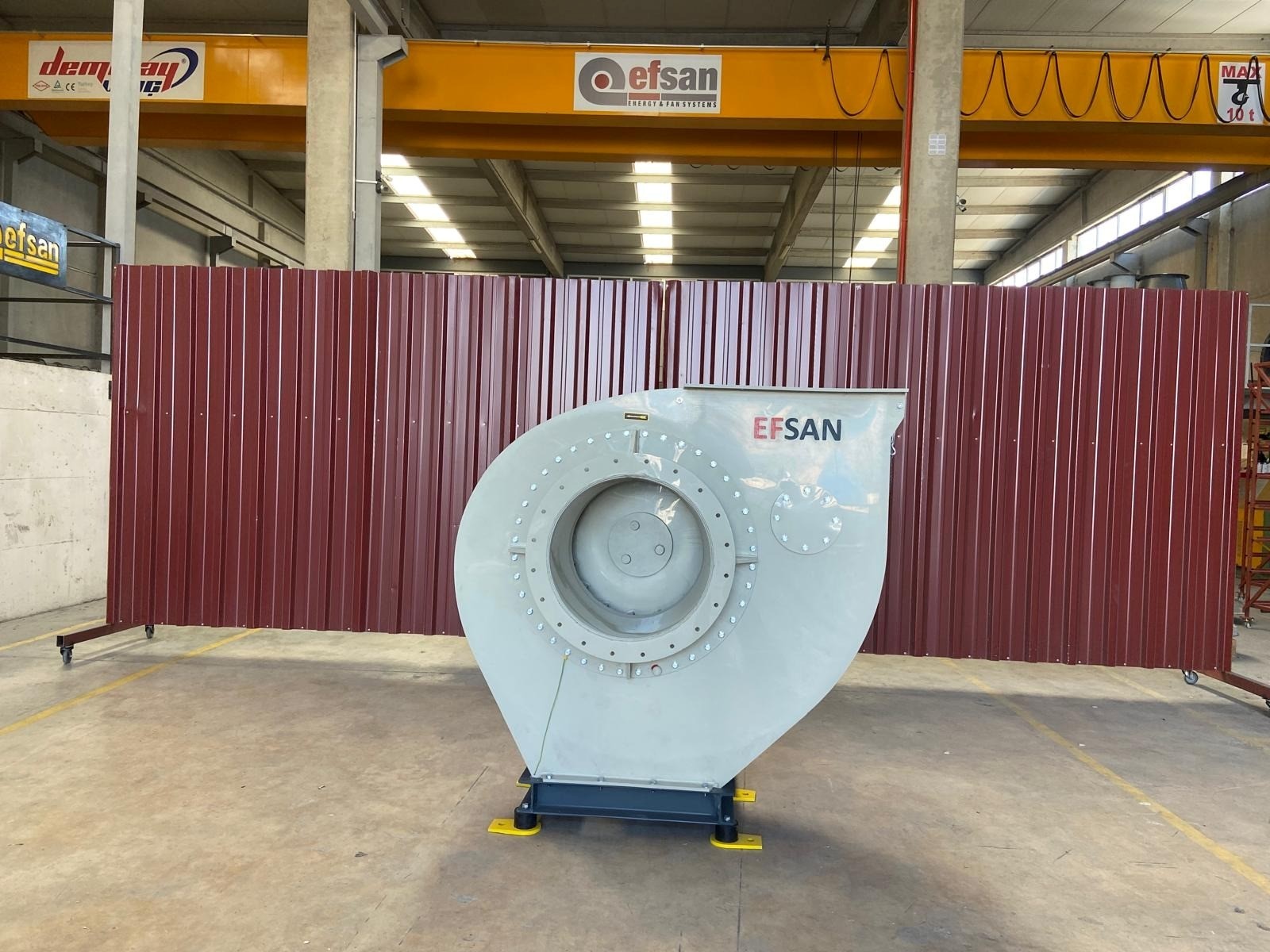
With its high production precision (laser cutting tolerances, CNC bending, dynamic balance tests) and industrial field experience, EFSAN projects ATEX fans in 100% EN 14986 standards, fully compatible with the Zone class of your process.
For Zone classifications specific to your facility, technical specification supports and project-specific solutions Efsan you can contact the engineering team.
Frequently Asked Questions (FAQ)
Can plastic fans be used in an ATEX (explosive) environment?
The scope of EN 14986’ is the mechanical design of fans; The standard does not say that plastic fans must be carbon-doped. Standard; It requires controlling the risk of electrostatic charge formation and discharge and is based on EN ISO 80079-36/-37 principles. Conductive or anti-static doped materials are a common solution in practice, but not the only mandatory method. The standard also requires specific evaluation of plastics for low thermal conductivity and electrostatic risk.
How often should ATEX fans be periodically maintained?
Although it varies depending on the pollution of the environment, operating time and dust load; Vibration (vibration) analysis and physical clearance (clearance) control should be performed for 6-month periods in order to prevent the risk of mechanical friction. A fan whose maintenance is neglected and whose bearings wear out may lose its mechanical tolerances over time, even if it complies with EN 14986’ during the production phase.
What does temperature class (T1-T6) mean in fans?
Temperature class that the fan and the engine above it can reach under normal operating or foreseeable fault conditions maximum surface temperature it expresses. For example, if the auto-ignition temperature of the gas in the facility is 150°C, it is mandatory to use a fan of at least class T4 (maximum surface temperature limited to 135°C) in the system.
Will the ATEX feature be compromised if the fan impeller balance adjustment is disrupted?
Yes. The imbalance that will occur in the propeller causes the shaft (shaft) to flex (deflect) at high speed. This may cause the wing tip gap required by EN 14986’ to close during operation and cause mechanical friction. Therefore, precise computerized dynamic balancing is a standard safety procedure during the production phase.
tags :
More about the sector and our business