Table of Contents
In industrial facilities, safety and regulatory compliance require the utmost precision, especially when working in explosive atmospheres. The ATEX Directive 2014/34/EU legally ensures which equipment can be installed in which hazardous area (zone) by classifying equipment into various categories based on the level of protection they provide. Fully grasping this system is vital both for making the right equipment investment and ensuring the safety of your facility.
As Efsan, with our years of engineering experience, we take these standards as a guide when designing industrial ventilation and explosion-proof (ex-proof) fan systems, ensuring your facilities operate at maximum safety with zero risk. In this comprehensive guide, we will examine technical details ranging from decoding ATEX markings to equipment groups, fault tolerances, and critical temperature classes.
The Art of Reading ATEX Labels Correctly
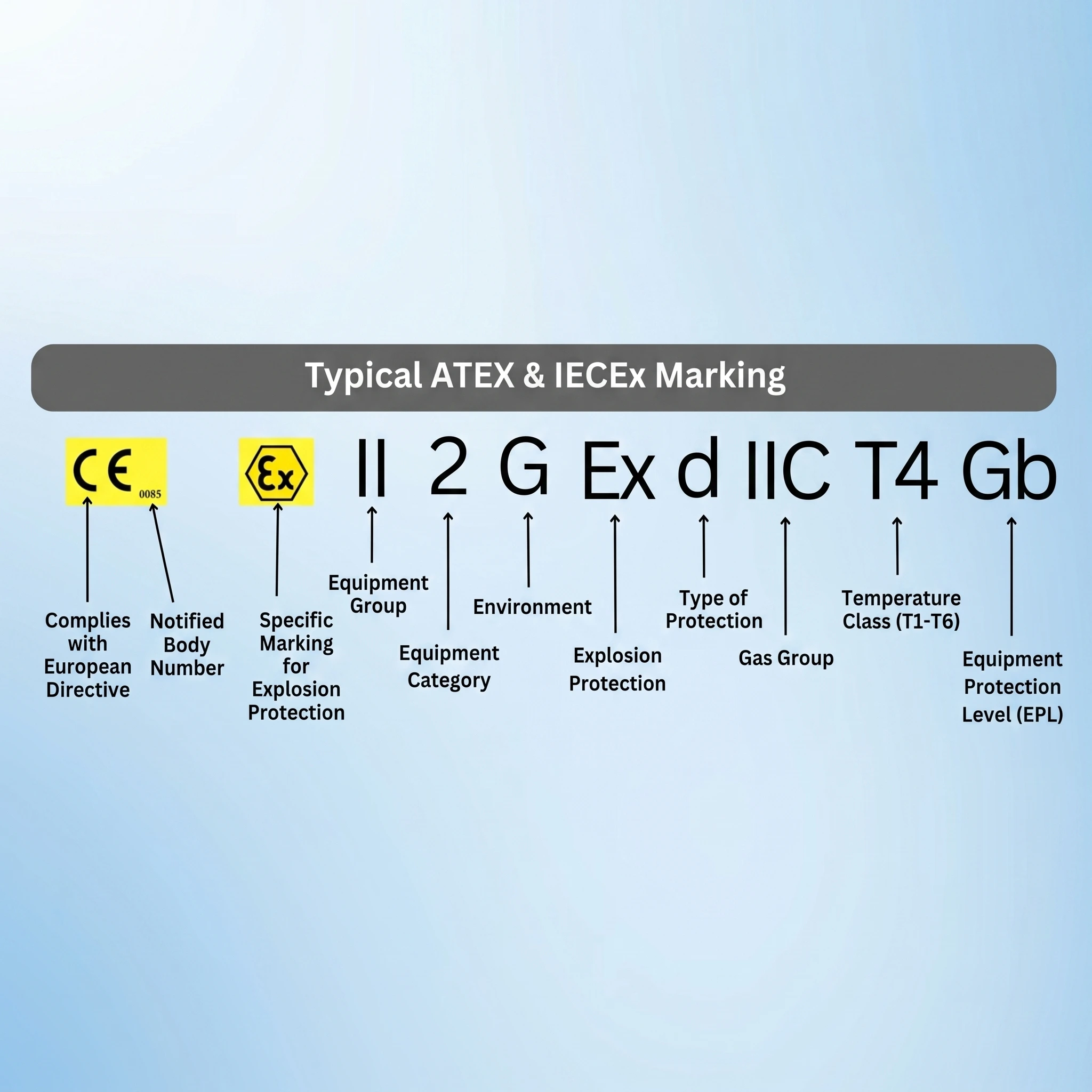
Analyzing an ATEX-labeled product correctly is the first step to safety. One of the common mistakes we encounter in the field is a superficial examination of labels. However, the reading order should be from left to right; starting with regulatory (legal) markings and then moving on to technical details. When examining a label, you should follow these steps:
- CE Mark and Notified Body Number: This mark acts as the product’s passport to the EU market and proves its compliance with relevant directives.
- ATEX Symbol (Ex): The famous “Ex” mark enclosed in a yellow hexagon indicates that the product is specifically designed for explosive atmospheres.
- Equipment Group and Category: Consists of a combination of Roman numerals, numbers, and letters (e.g., II 2 G). This part defines exactly which environments the fan or motor is manufactured for.
- Ex Marking: Details the device’s protection method (e.g., flameproof enclosure), gas group, temperature class, and EPL (Equipment Protection Level).
- Certificate Number: Provides traceability to the product’s Type Examination Certificate. A reliable manufacturer will always state this number clearly.
- Special Conditions: These are extra engineering notes regarding installation, usually indicated by the suffix “X” or specified separately.
- Ambient Temperature Range (Ta): Expresses the “Ta” (Ambient Temperature) limits within which the equipment can operate safely.
Equipment Groups: The Line Between Mining and Surface Industries
Before moving into complex categories, the ATEX system divides all equipment into two massive groups based on their fundamental structures and operating areas. This distinction, considered at the beginning of every project when providing industrial fan solutions, defines the nature of the hazard.
| Group | Target Industry and Application Area | Relevant Categories |
| Group I | Underground mines and surface installations at risk of methane gas/combustible dust. | M1, M2 |
| Group II | All other explosive atmospheres (oil, natural gas, chemical, pharmaceutical, paint plants, etc.). | 1, 2, 3 |
A large majority of industrial facility managers and process engineers work with Group II equipment. Group I (mining) equipment has its own completely different requirements; because in underground mines, the hazard (especially methane gas) is continuous, not momentary. Therefore, mining equipment is often expected to continue operating rather than being de-energized when an explosive atmosphere occurs.
Group II Categories and “Fault Tolerance” Engineering
If you operate a surface industry facility (Group II), your equipment is divided into three categories, each providing a different level of protection. The Group II details, frequently referenced in Efsan engineering systems and establishing the budget/safety balance, are as follows:
| Category | Protection Level | Suitable Zone | EPL (Gas) | EPL (Dust) | Fault Tolerance Summary |
| Category 1 | Very High | Zone 0, 1, 2 (gas) / Zone 20, 21, 22 (dust) | Ga | Da | Safe even in the event of two independent faults. |
| Category 2 | High | Zone 1, 2 (gas) / Zone 21, 22 (dust) | Gb | Db | Safe in the event of a single fault. |
| Category 3 | Normal | Zone 2 (gas) / Zone 22 (dust) | Gc | Dc | Safe only under normal operating conditions. |
What Does Fault Tolerance Mean in Engineering?
The category system is fundamentally about how many mechanical or electrical faults the equipment can “tolerate” before becoming an ignition source (spark or overheating):
- Category 1 (Two-Fault Tolerant): This is the highest level of safety. The equipment must remain safe even if two independent faults occur simultaneously. This typically requires redundant protective measures; for instance, an intrinsically safe circuit with two independent current-limiting barriers (Ex ia). It is the most difficult category to manufacture and has the highest investment cost.
- Category 2 (Single-Fault Tolerant): The equipment must remain safe even in the event of a single mechanical or electrical fault. Most industrial Ex equipment and Efsan’s heavy industry fans fall into this category. Flameproof motors (Ex d) or increased safety structures (Ex e) are the essentials of this category.
- Category 3 (Only Normal Operation Tolerant): The equipment is safe only during normal operation. If an unexpected fault occurs, it can become an ignition source. Therefore, it is only used in Zone 2 areas where the likelihood of explosive atmospheres occurring is very low and short-lived.
This article might interest you. Comprehensive Exproof Fan Selection, ATEX Standards and Application Guide
Zone Classification and Selection Hierarchy in Hazardous Areas
Below is the fundamental “Zone” table that every process engineer and facility manager needs.
| Hazardous Area | Hazard Level and Duration | Required Minimum Category | ATEX Marking Example |
| Zone 0 | Continuous explosive gas atmosphere (e.g., inside a tank) | Category 1G | II 1G |
| Zone 1 | Atmosphere likely to occur during normal operation | Category 2G (or 1G) | II 2G |
| Zone 2 | Unlikely to occur, if it does, it only exists for a short period | Category 3G (or 2G, 1G) | II 3G |
| Zone 20 | Continuous explosive dust cloud | Category 1D | II 1D |
| Zone 21 | Dust cloud likely to occur during normal operation | Category 2D (or 1D) | II 2D |
| Zone 22 | Unlikely to occur, if it does, short-lived dust | Category 3D (or 2D, 1D) | II 3D |
The Lifesaving Rule: Selection Hierarchy
The hierarchy rule always applies in purchasing decisions: Higher category equipment can always be used in lower-risk zones. Category 1 devices are accepted in Zones 0, 1, and 2. You might be paying for extra protection you may not need, but it is always compliant.
ATEX Label Decoding Example
Let’s say a fan motor has the following code on it:
⟨Ex⟩ II 2G Ex d IIB T4 Gb
The breakdown of this string according to Efsan engineering standards is as follows:
- II: Equipment Group II (manufactured for the surface industry).
- 2G: Category 2, suitable for use in Gas atmospheres.
- Ex d: The motor has a flameproof enclosure.
- IIB: Suitable for Gas Group IIB.
- T4: The outer surface of the motor cannot exceed 135°C under any circumstances (Temperature Class T4).
- Gb: The Equipment Protection Level (EPL) is Gb.
ATEX Label Quick Reference Checklist
When reading the ATEX nameplate in the field or during procurement, strictly verify the following steps for your facility’s safety:
- Zone Suitability: Ensure that the Category and EPL values match your classified zone (Zone 0, 1, or 2).
- Gas Group: Confirm that the IIA, IIB, or IIC designations cover the process gases in your facility.
- Temperature Class: Verify that the T-class value remains below the auto-ignition temperature of the gas in your environment.
- Ambient Temperature: Check if the field Ta (ambient) temperature remains within the equipment’s permissible Ta range.
- Special Conditions: If there is an X suffix, make sure to check it, request the product certificate, and read the details.
- Electrical Ratings: Ensure that the voltage, current, and frequency values are compatible with your facility’s existing power supply.
- Protection Method: Verify the exact suitability of protection methods for your application, such as Ex d for motors and Ex ia for sensors.
Common Engineering Mistakes During the Ex-proof Purchasing Phase
According to field inspections conducted by Efsan, incorrect equipment selection based purely on cost doesn’t just burn the budget; it destroys the safety of the entire facility. Here are the most critical mistakes frequently made in the industry:
- Violating the Gas Group Hierarchy: Using IIB equipment in a IIIC (conductive dust) or IIC (hydrogen) environment is inviting an explosion. The gas group hierarchy is strict: IIC equipment works everywhere, but IIB equipment cannot be operated in a IIC atmosphere. If you have hydrogen or acetylene in your zone, you need IIC class equipment.
- Exceeding Ambient Temperature (Ta) Limits: If you install a fan motor rated Ta: -20°C to +40°C on its label in an environment that reaches 55°C in the summer, the outer surface temperature of the motor will exceed its certified T-class. This creates a direct ignition risk for the facility.
- Confusing Zone with Category: Category 2 is suitable for Zone 1, but they are not the same thing. Zone is a classification of the location. Category is a rating of the equipment. You must match them correctly: Category 1 → Zone 0, Category 2 → Zone 1, Category 3 → Zone 2.
- Ignoring Stock Advantages for Over-Specification: A procurement process should prioritize the most widely available ex-proof products on the market. You pay extra for every safety measure indicated on the label. However, even if an in-stock product has features that exceed your requirements, you can still benefit from the price advantage of stock items. The markings that must be carefully evaluated in ex-proof products are the gas group and temperature class. For example, if a IIC hydrogen environment is not required, specifying it might force you to buy a non-stock ex-proof product, causing unnecessary cost increases.
What Do Temperature Classes (T1–T6) Mean?
The temperature class (T-Class) of Ex equipment defines the maximum surface temperature the equipment can reach during operation. This temperature must always remain below the auto-ignition temperature (AIT) of the gases or dust present in the equipment’s environment.
According to the current IEC 60079 and ATEX 2014/34/EU directives, the temperature classes are as follows:
| Temperature Class | Max. Surface Temperature the Device Can Reach (°C) | Safe for Which Gases? (AIT Value) |
| T1 | 450 | Gases with an AIT higher than 450°C |
| T2 | 300 | Gases with an AIT higher than 300°C |
| T3 | 200 | Gases with an AIT higher than 200°C |
| T4 | 135 | Gases with an AIT higher than 135°C |
| T5 | 100 | Gases with an AIT higher than 100°C |
| T6 | 85 | Gases with an AIT higher than 85°C |
The Golden Rule in Temperature Classes: A higher T-number = lower maximum surface temperature = a safer system for more gases. T6 certified equipment can be safely used in an environment of any temperature class (from T1 to T6). However, T1 equipment can only be used in situations where the auto-ignition temperature (AIT) exceeds 450°C. The hierarchy is as follows: T6 > T5 > T4 > T3 > T2 > T1 (T6 covers them all).
“Consult Efsan experts today for customized project planning, the right equipment selection, and competitive B2B offers tailored to your facility’s needs.”
Frequently Asked Questions (FAQ)
As Efsan, we are not just a product supplier, but an engineering partner that guarantees the safety of your facility. We analyze the ATEX Zone, gas group, and temperature class data your facility requires; and we provide solutions that are 100% compliant with international norms through non-sparking impellers, ex-proof certified motors, and anti-static housing designs. From your fan selection to the integration process, we are always by your side with the correct categorization.
Yes, you can. T4 class equipment guarantees that the surface temperature will rise to a maximum of 135°C. Equipment with a higher T-number (T4) is safe for more gas groups. Since the gas in your system ignites at 465°C, the device is completely safe, and T4 hierarchically covers T1.
No, this is the most confused topic in the industry. The Zone is the classification of the hazardous area in your facility. Category, on the other hand, is the durability rating of the equipment that will operate in this zone. For example, Category 2 equipment is designed for a Zone 1 environment.
Yes, you absolutely can. In ATEX directives, the hierarchy rule always applies: equipment in a higher category can always be used in lower-risk zones. Category 1 devices are accepted in Zones 0, 1, and 2. You might be paying for extra protection you may not need, but it is always compliant.
tags :
More about the sector and our business