

Table of Contents
When investing in a process fan or blower in industrial facilities, the most critical document that comes to the engineers’ desk is the fan performance curve. However, this curve fully adapts to your process; It depends on the correct reading of the air flow rate (m³/h) as well as the static and dynamic pressure values of the system.
Radial fan our engineering experience in manufacturing shows that the vast majority of capacity inadequacies encountered in the field are due to deficiencies in system resistance (static losses) calculations. In this guide, we will examine in detail the fluid dynamics of process fans and how to manage system pressure parameters.
Static, Dynamic and Total Pressure Concepts
The basic principle of fluid dynamics Bernoulli according to the equation, the energy of the gas flowing in a channel consists of basic components. It is imperative that a process engineer clearly distinguishes these parameters.
What is Static Pressure?
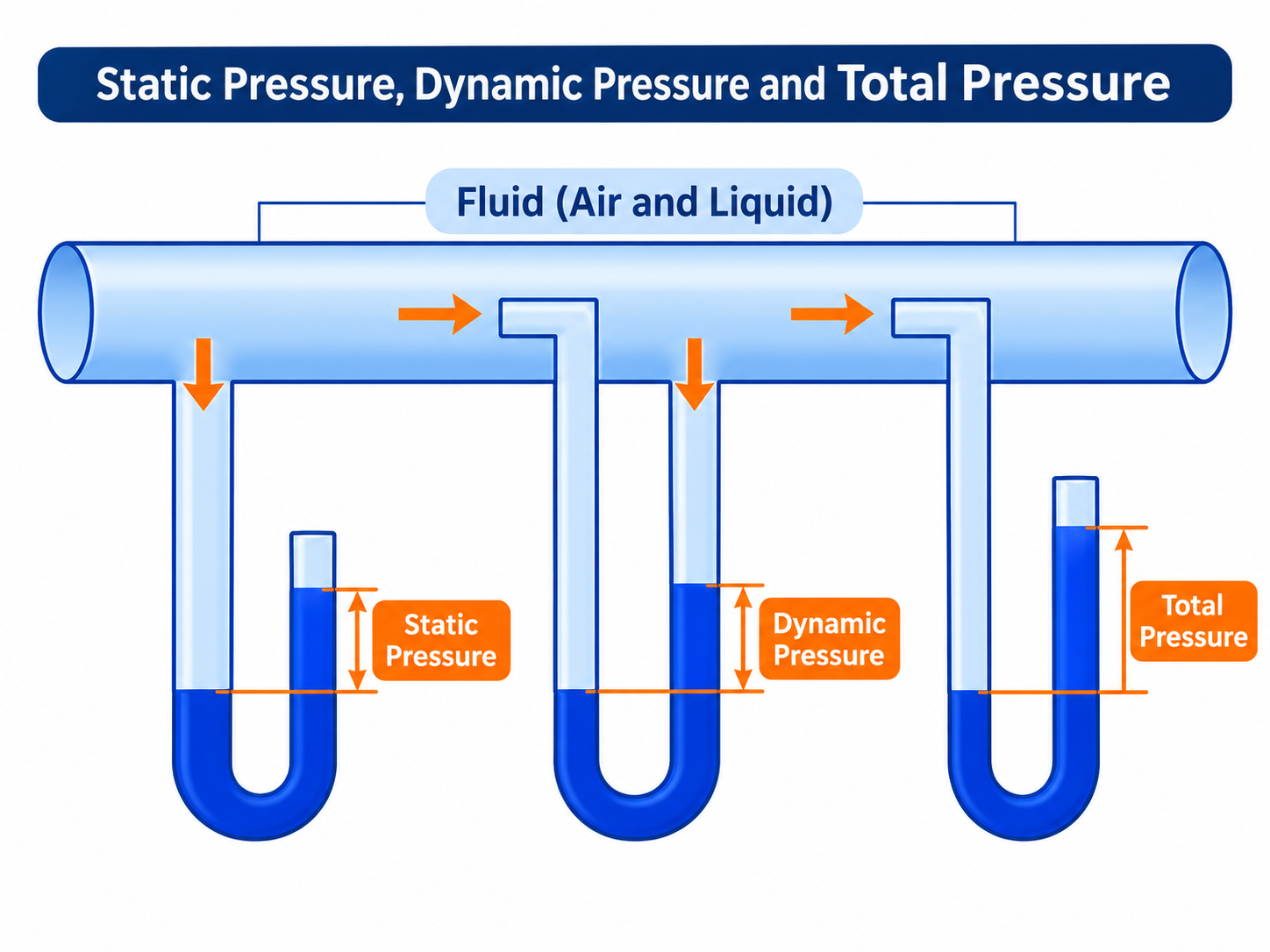
Static pressure (Ps) is the perpendicular force exerted by air (or transferred process gas) in all directions on channel walls, pipes, cyclones and filters. It is the actual “potential” energy that the fan must produce to overcome friction losses and equipment resistances within the pipe. Mostly mmSS (millimetre water column) or Pa (Pascal) it is measured in terms of. When you inflate a balloon, the pressure exerted on the walls from the inside is the most basic example of static pressure.
What is Dynamic Pressure?
Dynamic pressure (Pd) is the kinetic energy that occurs depending on the speed (motion) of the air. It only acts in the direction of flow. As the speed of the fluid increases, the dynamic pressure increases in proportion to its square. In dust collection or pneumatic conveying lines, a certain minimum dynamic pressure is needed to transport the material (eg cement dust, sawdust) without settling.
Differences Between Static and Dynamic Pressure
- Effect Direction: While static pressure acts on the pipe walls in all directions (360 degrees), dynamic pressure acts only in the flow direction of the air.
- Function: Static pressure is the energy required to overcome physical obstacles (filters, elbows) in the system. Dynamic pressure is the speed energy that allows mass (gas or particles) to be transported to the line.
- Measurement: Static pressure is measured with a probe placed at right angles to the line, while dynamic pressure is calculated by holding the Pitot tube against the flow (in the direction of impact).
How to Calculate Total Pressure?
Total pressure (Pt) is the total energy transferred by the fan to the fluid. Its calculation is quite simple; it’s an algebraic sum of static and dynamic pressures:
Pt = Ps + Pd
Effect of Channel Cross-Section Area and Air Velocity on Pressure
Diameter contractions or expansions are common in process lines. According to the continuity equation (Q = V x A), while the flow rate (Q) is constant, when the channel cross-sectional area (A) narrows, the air speed (V) increases out of necessity.
How is this reflected in pressure? Because the speed will increase when the channel narrows dynamic pressure rises. However, since the total energy (except for friction losses) has to remain constant (Bernoulli’s principle), at this point of contraction where the dynamic pressure increases static pressure drops.
One of the biggest mistakes in industrial facilities is the sudden narrowing of the pipe diameter for acceleration purposes. Although this increases the speed, it reduces the static pressure so much that the fan cannot exceed the resistance created by the filter or cyclone.
This article may interest you. What is Ethanol? Global Ethanol Market, Production and MVR Applications
How to Evaluate Fan Inlet and Outlet Pressures?
The job a process fan does is to overcome the pressure difference (differential pressure) between the input (suck) point and the output (shot) point of the system.
- Fan Suction (Input) Pressure: The fan creates a vacuum at the inlet port to draw in air. Therefore, the static pressure in the suction line negative (-) it is worth If the filters are in the suction line, this negative pressure gets deeper as they get dirty.
- Fan Shot (Output) Pressure: The fan transfers positive energy to the line where it prints air. Output static pressure positive (+) it is worth
What the fan must beat Total Pressure of Fanis the absolute difference of the total pressure at the outlet point and the total pressure at the suction point. The higher the vacuum (negative pressure) value in the suction line, the higher the load on the fan’s motor will increase.
What Value Should Be Used in Fan Selection: Static Pressure or Total Pressure?
This issue is one of the most frequently discussed engineering decisions in project offices. Our clear recommendation as Efsan is this: In industrial processes, Fan Static Pressure (FSP) should be taken as reference when determining the operating point of the fan.
From where? Because dynamic pressure (velocity energy) is an energy that is lost when thrown into the atmosphere or a large reactor through the fan’s outlet, “which cannot be used” to overcome system resistances (filters, etc.). If you choose the fan only based on “Total Pressure” and the output speed of the fan is very high, most of that high total pressure you have actually means dynamic pressure (speed). The remaining static pressure part may not be enough to exceed the bag filter in the line and the system goes into a “stall” (collapse) state.
Effect of Gas Density and Temperature on Process Fan Pressure
The most critical parameter that is often ignored but crashes systems in industrial applications is gas density (density).
Standard fan tests and catalog data are available at sea level and 20°C ambient temperature (1.2 kg/m³ air density) calculated. However, if you are transferring a high-temperature process gas, the air expands and its density decreases. When the density decreases, the volumetric flow rate (m³/h) of the fan does not change; however the static pressure it can produce and the power it draws fall in direct proportion to the density.
For example; The density of a gas at a temperature of 250°C is approximately 0.67 kg/m³’. A standard radial fan designed for 500 mmSS pressure for 20°C can only produce ~280 mmSS static pressure when placed on this line. Therefore, process fan selections should always be based on operating temperature “density correction calculations”.
Pressure Loss Calculation in Dust Collection and Pneumatic Transmission Systems
There are huge foci of static resistance in heavy-duty dust collection units and process lines:
- Local Losses (Fittings): Turbulence losses in elbows, T-joints and dampers.
- Equipment Losses: Static resistance created by cyclone separators, scrubbers (scrubber) and bag filters.
While the system total resistance is found, all these ΔP losses in the line must be collected and the filter fully loaded (dirtiest) a static pressure reserve should be left based on its resistance at the time it occurs.
Checklist: On-Site Pressure Measurement with Pitot Tube
If your current process blower does not meet system requirements, on the pipe Pitot Tube measurement must be made with:
- [ ] Selection of Measurement Point: The measuring port must be opened to a straight line where turbulence ends, at least 5-8 times the air duct diameter after the elbow or fan.
- [ ] Static Measurement: The static resistance of the system is read using the side holes (outer membrane) of the pitot tube.
- [ ] Total Measurement: The tip of the pitot tube is turned to the air flow direction, measuring the impact (total) pressure.
- [ ] Dynamic Pressure Calculation: The actual line speed is found by subtracting the static pressure from the total pressure read by the device.
Misconceptions: “Dynamic Pressure” and “Dynamic Balance” Confusion
Wrong: “Flicker at high revs is a dynamic pressure problem.” Correct: The flicker of an industrial fan is caused by an imbalance in the mechanical center of gravity of the rotor, i.e dynamic balance (vibration) it is caused by the problem. Dynamic pressure it is entirely the kinetic energy of the fluid in the channels. The two concepts are unrelated from an engineering standpoint.
Efsan: Reliable Industrial Fan and Process Blower Manufacturer for Heavy Industry
The process requirements of industrial plants (cement, iron and steel, petrochemicals, power plants, etc.) are too specific and demanding to be solved by standard catalogue fans. Efsan as for lines where dust load, corrosive gases and high temperatures are involved; specific to your project’s static resistances, altitude and gas density industrial radial fans and the process blowers we design and produce.
Our aim is not just to sell equipment; To offer permanent engineering solutions that optimize energy consumption and eliminate fault downtime by combining the fan performance curve with your system resistance curve at the highest efficiency (efficiency peak) point. Directly with our company for all engineering processes, from rotor design to static pressure optimization, for your heavy-duty fan needs contact you can pass
Frequently Asked Questions (FAQ)
What do static pressure losses depend on? It depends on the pipe diameter, the internal surface roughness of the channel, the number of elbows/clappers on the line, the air speed (increased by the square of the speed) and the impedance of equipment such as cyclones/filters on the line.
Why is static pressure minus in fan suction? The fan must create a value below atmospheric pressure (or the current pressure in the line), namely a vacuum, in order to draw air from the process line towards it. Therefore, the measured static value is negative.
What happens if static pressure is insufficient in process blowers? The system enters the region of “stall” (collapse) or “surge” (surge). Since the fan cannot push the gas against resistance, the flow rate drops drastically, the line becomes blocked and the fan rotor may be exposed to unstable loads and cause serious mechanical damage.
Can I increase the pressure of my current fan by increasing the engine speed? Yes (According to Fan Laws, pressure increases in proportion to the square of the revolution). However, the power drawn by the engine is up to speed cube since it will increase in proportion to, it must be checked whether the kW capacity of your current engine will handle this increase.
tags :
More about the sector and our business