Table of Contents
It is not enough to know only flow rate and pressure values when choosing an industrial fan. It is also important by what test method a fan achieves the specified performance, according to what criteria the rotor balance is evaluated, how vibration levels are measured and, when necessary, how sound performance is determined.
At this point AMCA (Air Movement and Control Association International) the standards published by constitute an important technical reference for fan manufacturers and users.
Especially radial fans, centrifugal fans, industrial process fans and high pressure fans for AMCA standards; It provides a common technical approach to performance testing, balance, vibration and acoustic measurements.
In this article, we discuss AMCA’s role in the fan industry and especially AMCA 210, AMCA 204 and AMCA 300 we will examine what their standards mean. Also in fan performance tests Differences between AMCA and ASME standards we will also mention it.
What is AMCA?
AMCA, the Air Movement and Control Association International it is an abbreviation of.
AMCA; It is an international organization that develops standards, test methods and technical publications on fans, air movement equipment and air control equipment.
The main purpose of AMCA standards in the fan industry is to provide performance data from different manufacturers to be determined by defined and repeatable test methods it is to provide
For example, for a centrifugal fan:
- Air flow rate
- Static pressure
- Total pressure
- Fan power
- Turnover number
- Fan efficiency
values such as are measured under specific test conditions.
In this way, the performance values given by the fan manufacturer can be evaluated more meaningfully.

This article may interest you. Industrial Dedusting Systems: How to Design Fan, Filter and Suction Systems?
Why is AMCA Important in Industrial Fans?
In a fan’s technical datasheet, for example:
50,000 m³/h @ 5,000 Pa
having a statement alone is not enough.
This value:
- at what air density,
- in what era,
- in which test setup,
- using which pressure definition, the
- by what measurement method, the
- within what tolerances
it should be known that it has been obtained.
Especially In EPC projects and process fan applications, this issue is of great importance when comparing offers from different fan manufacturers.
One of the main advantages provided by the AMCA standards is that they establish a common technical framework for the evaluation of fan performance.
What is AMCA 210?
Fan Aerodynamic Performance Test Standard
One of the most common AMCA standards in the fan industry AMCA 210‘stop.
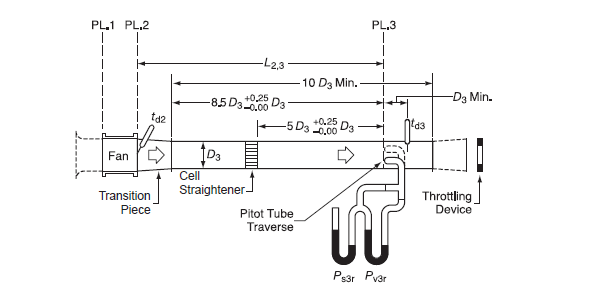
AMCA 210, of fans and air movement devices determination of aerodynamic performance under laboratory conditions defines the test methods used for.
Among the basic parameters used in determining fan performance within the scope of the standard:
- Air flow rate
- Pressure
- Power
- Turnover
- Air density
- Fan efficiency
it is found
Therefore, AMCA 210 is a fan’s establishing the performance curve and validating the operating points It is an important reference in terms of.
What is Measured in the AMCA 210 Fan Performance Test?
The main goal in a fan performance test is to determine how the fan behaves at different operating points.
For example, at different flow points during testing:
Flow → Pressure → Power → Efficiency
its relationship can be determined.
As a result, performance curves of the fan are created.
In a typical fan performance curve, it can be seen how the pressure that the fan can provide changes as the flow rate increases. At the same time, the power and efficiency values are evaluated and the operating point of the fan is analyzed.
This is especially important in process fans.
Because only:
“The fan supplies 50,000 m³/h of air.”
instead of saying;
“The fan provides a pressure of 5,000 Pa at a flow rate of 50,000 m³/h and operates at a certain power consumption at this operating point.”
an evaluation should be made as follows.
Why is the Fan Performance Curve Important?
One of the most critical issues in fan selection is the fan’s system to operating point it fits correctly.
What the system needs:
- Debi
- Static pressure
- Total pressure
once their values are determined, the appropriate operating point is selected on the fan’s performance curve.
Wrong fan selection;
- To higher than necessary energy consumption,
- Insufficient air flow rate,
- Excessive vibration,
- To noise,
- Choosing the engine unnecessarily large,
- Decrease in the process performance of the system
may cause.
Therefore, determining fan performance with a standardized test method is especially important in high-capacity industrial fans.
What is AMCA 204?
Fan Balance and Vibration Standard
Another issue as important as fan performance it is the mechanical behavior of the rotor.
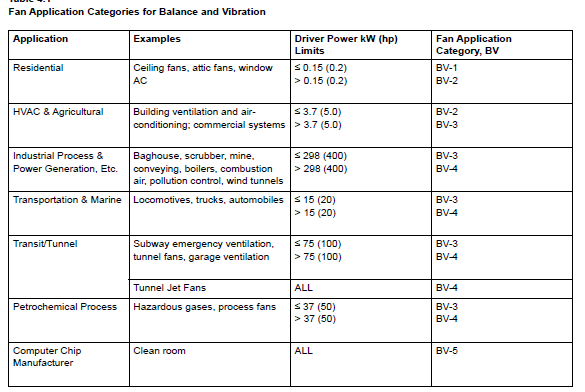
AMCA 204, in fans balance quality and vibration levels It is one of the standards that addresses the requirements related to.
If a fan rotor does not have sufficient balance quality, centrifugal forces occur during operation.
This situation:
- Increasing bed loads,
- Dynamic load on the shaft,
- Coupling problems,
- Increasing the vibration level,
- Reduced bed life,
- Mechanical problems on the fan and motor
may cause.
For this reason, rotor balancing is a critical issue, especially in high speed and high power industrial fans.
Fan Vibration on AMCA 204’
Balance quality and vibration are not the same thing.
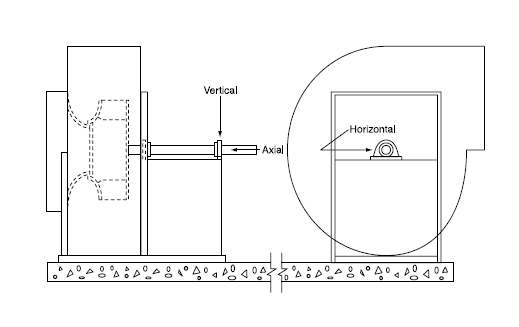
Balance, is related to the smoothness of the rotor’s mass distribution.
Vibration it is the measurement of the mechanical movement of the fan that occurs during operation.
Fan vibration may not just be caused by unbalance.
For example:
- Bearing problems
- Shaft curvature
- Coupling misalignment
- Rotor deformation
- Loose connections
- Aerodynamic problems
- Resonance
- Foreign matter accumulation
it may also cause vibration.
Therefore, in industrial fans, it is not just balancing the rotor also checking the vibration level created by the fan during operation must.
AMCA 204 and Rotor Balance
In industrial radial fans, rotor balancing is often an important part of the manufacturing process.
Especially:
- Large diameter rotors
- High speed fans
- High power fans
- High pressure fans
- Continuously operating process fans
for balance quality becomes even more important.
Mechanical performance can be verified by checking the vibration values in the operating conditions of the fan after balancing the rotor.
This approach contributes to the long-term and reliable operation of the fan.
What is AMCA 300?
Sound Test on Fans
Fan performance is not just about flow rate and pressure.
In some projects created by fans sound level it is also an important design criterion.
AMCA 300is one of the test methods for determining the airborne sound performance of fans.
The standard is for evaluating the sound created by the fan under laboratory conditions reverberation room (reverberation room) uses method.
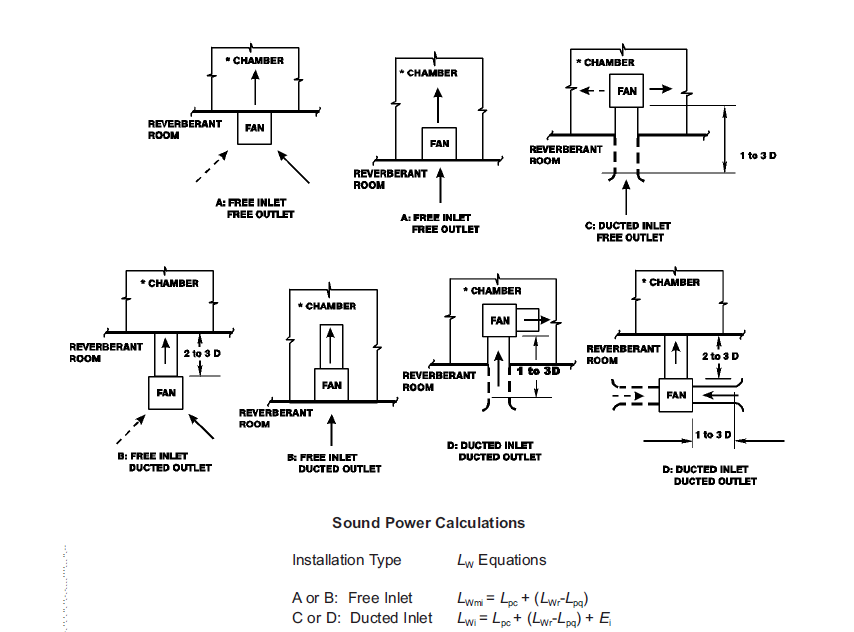
Difference Between AMCA 210, AMCA 204 and AMCA 300
Although these three standards are occasionally referred to together they do not cover the same subject.
| Standard | Basic topic |
| AMCA 210 | Fan aerodynamic performance |
| AMCA 204 | Balance and vibration |
| AMCA 300 | Fan sound test |
In other words:
AMCA 210 → How much air and pressure does the fan provide?
AMCA 204 → How stable is the fan mechanically and how much vibration does it create?
AMCA 300 → How much sound does the fan create?
These standards are not alternatives to each other. Depending on the need, more than one standard reference can be made in the same fan project.
What is AMCA 803?
Field Performance Testing in Industrial Fans
Fan performance testing performed in a laboratory and testing performed in a real facility are not the same thing.
When the fan is installed in the real system;
- Channel geometry,
- Elbows,
- Dumpers,
- Entry conditions,
- Exit conditions,
- System resistance,
- Flow disorders
it may affect the actual operating performance of the fan.
Therefore in industrial process fans field performance tests it also becomes important.
AMCA 803 is one of the AMCA publications used for field performance testing of industrial process and power generation fans.
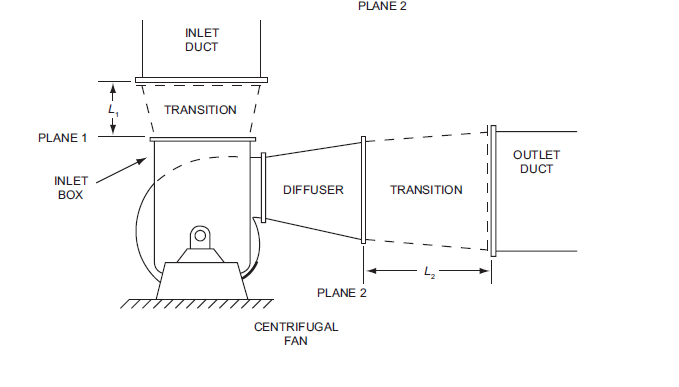
Difference Between Laboratory Test and Field Test
The purpose of the laboratory test is to determine the performance of the fan in controlled conditions.
In field testing, the fan behavior within the actual facility evaluated.
For example, in a laboratory environment, the fan:
100,000 m³/h @ 8,000 Pa
it may have performance.
However, if there are bad entry conditions or high system effects in the duct system to which the fan is connected, it may not be possible to achieve the same performance in the actual plant.
Therefore, especially in large process fans system design is as important as the fan.
What is the Difference Between AMCA and ASME?
In fan projects, AMCA and ASME standards may sometimes appear in the same technical document.
However, their intended use is not the same.
AMCA’s standards for fans are mainly:
- Fan performance
- Balance
- Vibration
- Sound
- Field performance
It focuses on topics such as.
On the ASME side, it is different Performance Test Code there are standards and which code to use varies depending on the equipment and test purpose.
Because:
“Testing will be done according to ASME.”
the statement alone is not enough.
It should be clearly stated which ASME PTC standard is desired.
AMCA 210 or ASME PTC 10?
It is necessary to be more careful here.
ASME PTC 10is a Performance Test Code for performance testing of axial and centrifugal compressors.
For this reason, it is possible to encounter the PTC 10 specification in high-pressure process blowers or compressor equipment.
However, a classical industrial radial fan and a process gas compressor/blower should not be considered in the same way.
Therefore, when determining the test standard for the fan or blower:
- Working pressure of equipment
- Pressure ratio
- Gas/air characteristics
- Fan or blower classification
- Project specifications
- Performance guarantee
- Whether the test will be done in the laboratory or in the field
should be considered together.
If ASME PTC 10 is explicitly stated in the customer specification, it should not be assumed that the PTC 10 requirement is met by simply saying “we tested according to AMCA 210’”.
Which AMCA Standard is Used in Industrial Radial Fans?
The standard to be used in an industrial radial fan project can be determined according to the technical requirements of the fan.
For example:
Performance test
AMCA 210
Determination of fan flow, pressure, power and aerodynamic performance.
Rotor balance and vibration
AMCA 204
Evaluation of the balance quality of the fan rotor and vibration levels of the fan.
Sound
AMCA 300
Testing fan-induced airborne sound.
Field performance
AMCA 803
Evaluation of the performance of the industrial process fan in real plant conditions.
It is not mandatory to use all of these standards in the same project. The project specification and the intended use of the fan determine what tests are required.
The Importance of AMCA Standards in Fan FAT
In fan production FAT (Factory Acceptance Test) the phase is an important phase in which it is checked whether the equipment meets the technical requirements set before shipment.
Depending on the requirements of the project in a fan FAT procedure:
- Visual control
- Measurement control
- Rotor balance control
- Vibration measurement
- Turnover control
- Motor current/power
- Fan performance
- Leak controls
- Sound measurement
there may be different controls such as.
Here, which test will be performed according to which standard It must be defined in advance in the ITP and project technical specifications.
What Should Be Considered When Choosing a Fan Test Standard?
The following issues should be considered together when determining the fan test standard:
- Fan type
- Flow rate and pressure level
- Properties of air or process gas
- Operating temperature
- Turnover number
- Engine power
- Laboratory or field testing
- Performance guarantee
- Customer technical specification
- Other standards referenced by the project
Instead of automatically applying a single standard for each fan, especially in the process industry, the determining the appropriate test procedure according to the actual operating conditions of the equipment must.
Conclusion
AMCA standards offer important technical references for the evaluation of performance and mechanical properties of industrial fans.
Especially:
AMCA 210 → Aerodynamic performance
AMCA 204 → Balance and vibration
AMCA 300 → Sound test
AMCA 803 → Field performance test
stands out in its subjects.
Industrial radial fans choosing the right standard is not only for the manufacturer; Also for EPC companies, process engineers and end users it matters.
Because the correct testing standard is based not only on the fan’s values on the catalog true engineering performance and mechanical reliability it enables more accurate evaluation.
In addition to AMCA standards, especially in high pressure and process applications project specifications, API standards and ASME Performance Test Code requirements when necessary should be considered together.
AMCA Standards in Industrial Fans: Frequently Asked Questions (FAQ)
What are AMCA standards and why are they important in fan selection?
AMCA (Air Movement and Control Association International) is an international organization that enables the measurement of performance, vibration and sound values of fans using standard and repeatable methods. Pure flow rate and pressure declaration on the catalog is not sufficient when choosing a fan. AMCA standards allow you to accurately compare technical offers from different manufacturers, making it transparent under which test conditions these values are obtained (air density, measurement method, tolerances).
What values are measured in the AMCA 210 fan performance test?
The AMCA 210 aerodynamic performance test, carried out in a laboratory environment, analyzes the aerodynamic behavior of the fan at different operating points. The key parameters measured under the standard are:
- Air flow rate and air density
- Static and total pressure
- Fan motor power and speed
- Overall fan efficiency
What is the difference between AMCA 204 and AMCA 300 standards?
Both standards measure the fan’s mechanical stability and environmental effects, but their focus is completely different:
- AMCA 204 (Balance and Vibration): It determines the balance quality of the fan rotor and the vibration levels generated during operation. Critical for bearing life and mechanical safety.
- AMCA 300 (Audio Test): It tests the sound performance created by the fan and emitted from the air under laboratory conditions (in the reverberation room).
Do laboratory testing (AMCA 210) and field testing (AMCA 803) give the same result?
It doesn’t always give. AMCA 210 tests the fan under ideal and controlled laboratory conditions. However, when the fan is installed in a real system; System effects such as duct geometry, elbows, input-output conditions and dampers directly change performance. Therefore, the AMCA 803 field performance test is applied to verify the operating behavior in real plant conditions.
Are AMCA and ASME standards interchangeable in industrial fans?
No, equipment classes and testing procedures vary. While AMCA standards focus on standard radial, centrifugal and process fans; ASME (especially ASME PTC 10) is a code written for performance testing of axial and centrifugal compressors/blowers. In high-pressure process equipment, action should be taken according to the project specification, it should not be assumed that the pure “AMCA 210” test automatically meets the requirements of ASME PTC 10.
Don’t leave the performance your system needs to chance. For our industrial fan solutions that fully comply with AMCA standards and have completed laboratory and field tests Efsan with our engineering team immediately contact go ahead.
tags :
More about the sector and our business