Table of Contents
Every minute of unplanned downtime at energy production facilities translates into massive production losses and difficult-to-remedy safety risks. In particular, insufficient oxygen supply or the inability to discharge waste gases in boiler areas can cause the process to virtually suffocate. The power plant fan systems operating in the combustion and exhaust lines at the heart of your operation do not merely provide simple air circulation; they maintain the entire thermodynamic balance of the facility.
How Do Power Plant Fan Systems Determine Process Efficiency?
Power plant fan systems are critical air transfer equipment, resistant to high flow rates and temperatures, used to ensure ideal combustion in industrial boilers and to discharge corrosive waste gases.
No matter how high a power plant’s gross electricity generation capacity may be, the ‘internal consumption’ energy expended by the plant’s internal equipment directly affects profitability. According to industry standards, a significant portion of a power plant’s internal consumption is expended by boiler feed pumps and large-capacity industrial fans. At this point, an aerodynamically undersized fan system continuously draws unnecessary power from the grid.
Not only energy consumption but also the stability of the process depends on this equipment. The flow rate of the air entering the boiler and the gas exiting must be balanced within milliseconds (draft control). Otherwise, combustion efficiency decreases, emission values exceed legal limits, and thermal stress occurs in the equipment.
Fan Systems Used in Thermal Power Plants and Their Critical Functions
In thermal power plants, primary air fans (PA) that transport coal, forced draught fans (FD) that supply combustion air, and induced draught fans (ID) that remove waste gases work in an integrated manner to ensure boiler efficiency.
Thermal power plants operate on the principle of burning fossil fuels (usually coal) in high-capacity boilers. For this massive combustion reaction to proceed healthily, enormous amounts of air must be managed with very precise pressure values. The following basic fan types are at the heart of thermal power plants:
Primary Fan (PA Fan / Primary Air Fan)
The forced draught fan draws fresh air from the atmosphere, passes it through air heaters, and forces it directly into the boiler. Its purpose is to provide the oxygen required for complete and efficient combustion of the fuel. They create positive pressure in the system. PA fans generally operate with cleaner air, so the risk of corrosion or wear is lower than with ID fans; however, as they operate at very high flow rates, the aerodynamic blade profiles must be flawless, which is critical for energy savings.
Induced Draft Fan (ID Fan)
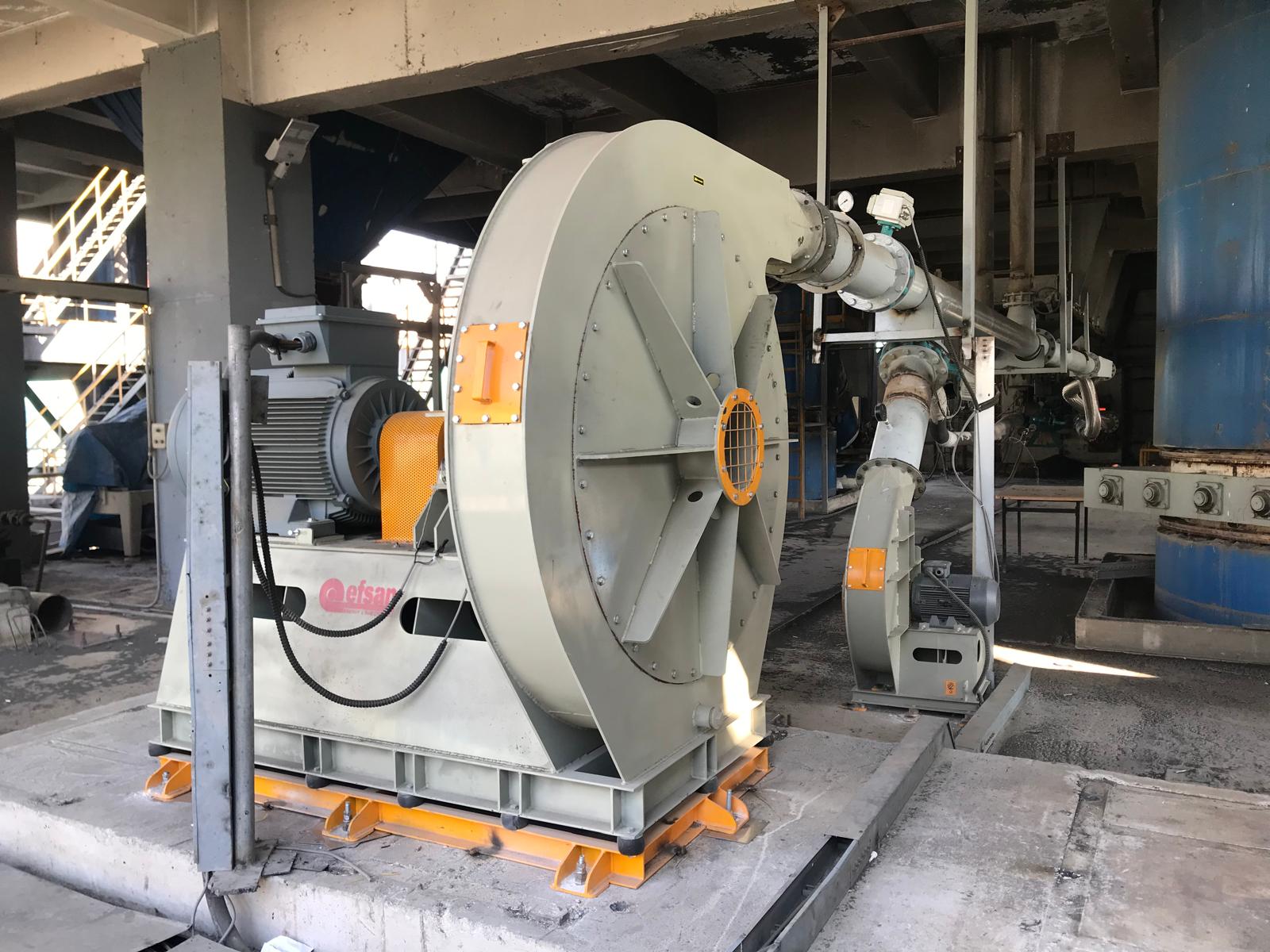
It is one of the hardest working components of the system. It draws in the extremely hot, dusty and corrosive flue gases produced by combustion and conveys them to the filter systems (ESP, FGD) and then to the stack. It creates a slight negative pressure (vacuum) inside the boiler, preventing the flame and toxic gases from escaping into the power station. As ID fans operate at high temperatures, they must be equipped with special cooling systems and acid-resistant materials.
This article may be of interest to you. Power Plant Fan Systems
Fan Selection and Challenges in Biomass Power Plants
Biomass power plant fans must be resistant to variable fuel moisture levels and dense ash particles; they should be designed with special backward-curved or radial blade profiles to prevent clogging.
Biomass power plants, which burn agricultural waste, forest products or animal waste, have a much more variable combustion profile than thermal power plants. The moisture content of the fuel constantly changes, which challenges the pressure balance in the combustion chamber.
A common situation encountered in the field is the attempt to integrate standard design fans into biomass plants. The ash produced by biomass combustion tends to adhere to the blade surfaces (slimming/fouling). Over time, this layer accumulating on the blades disrupts the fan’s static and dynamic balance. Therefore, in biomass ID fans and gas extraction lines, self-cleaning blade aerodynamics that minimise dust adhesion should be preferred. Otherwise, the plant will be forced to shut down frequently for fan cleaning.
Corrosion and High Temperature Management in Waste Incineration Plants
Fan systems in waste incineration plants must be manufactured from specially coated materials with high corrosion resistance, as they are exposed to extremely aggressive chemical gases such as chlorine and sulphur.
Plants that convert domestic or industrial waste into energy (Waste-to-Energy) are one of the most challenging tests for fan engineering. The heterogeneous structure of the material being incinerated causes the formation of highly corrosive components such as chlorides, fluorides and sulphur dioxide in the flue gas. A fan rotor made of normal carbon steel can completely corrode within a few months in such a plant.
Gas Recirculation Fan (GRF) and Emission Control
Gas Recirculation Fans (GRFs) play a key role in waste incineration plants and new generation low-emission power plants. These fans take part of the waste gas going to the chimney and push it back into the combustion chamber. This process has two purposes:
- To reduce the peak temperature in the combustion chamber, bringing hazardous NOx (nitrogen oxide) emissions below legal limits.
- To balance the thermal flow inside the boiler, increasing the efficiency of heat transfer surfaces.
Since recirculation fans operate at very high temperatures (between 300°C and 400°C) and with ash-laden gas, thermal expansion calculations must be performed flawlessly.
Which Type of Industrial Fans Are Used for Which Processes?
In power plants, depending on the process needs, induced draft fans (ID) are preferred for fresh air (PA), for evacuation of combustion gases, and Recirculation Fan (GRF) for temperature balance inside the boiler.
Different process stages require different aerodynamic dynamics. According to the structure of the facility, fan types are classified as follows in generally accepted applications:
| Fan Type / Nomenclature | Basic Function and Place of Use | Critical Design Feature |
| Forced Draft (ID) Fans | It discharges waste and hot gases from the boiler. | High static pressure, temperature and corrosion resistance. |
| Recirculation (GRF) Fans | Lowering the peak temperature in the combustion chamber | High particle and corrosion resistance. |
| Primary Air (PA) Fans | It pumps fresh air into the combustion chamber. | High pressure, clean air aerodynamics. |
Common Engineering Mistakes and the Correct Approach
In plant projects, incorrect sizing of fan capacities, incorrect material selection, and inadequate calculation of system resistance result in enormous operating costs and chronic failures.
The fundamental errors we have observed in practice over the years, which cause serious damage to facilities, are as follows:
- Oversizing: Fans selected well above requirements based on the ‘better safe than sorry’ mentality operate outside their nominal efficiency points. This leads to energy waste, even when a variable frequency drive (VFD) is used.
- Cold/Hot Gas Density Error: If the density of the gas to be drawn by the fan is not taken into account during system design, the motor power is incorrectly determined. This creates a risk of motor burnout, especially during the initial start-up (cold start) of ID fans.
- Neglecting Acoustics and Vibration: If the natural frequencies of the steel structures or concrete bases where these heavy-duty fans are installed are not calculated, they will resonate with the fan’s rotation speed. This vibration will quickly destroy the bearings.
- Incorrect Bearing and Cooling Selection: In fans carrying gas above 250°C, the heat transferred from the body to the shaft burns the bearings. Not including cooling discs or forced oil circulation bearing systems in the project is a major engineering oversight.
(By leveraging Efsan‘s expertise, you can request a technical analysis report tailored to your facility and prevent potential hidden costs during the design phase.)
Heavy Duty Fan Technologies Special to Your Facility with Efsan
From the harsh wear conditions of coal-fired power plants to the corrosive effects of waste incineration plants and the variable structures of biomass processes, the “breathing” of every process depends on the right fan technology. From FD fans to ID fans, from primary fuel combustion systems to emission-reducing recirculation fans, all your power plant fan systems needs are met not through the catalogue; It should be designed specifically for the facility according to the rules of fluid mechanics and thermodynamics.
Our experienced engineers are with you to reset your business’ downtime, optimize energy bills and produce aerodynamic solutions suitable for capacity increase.
Contact Efsan experts today for real engineering solutions and capacity/aerodynamic measurements specific to your facility and secure your process efficiency.
tags :
More about the sector and our business