Table of Contents
Ventilation and process-specific airflow in industrial facilities are critical not only for environmental comfort but also for production quality, energy performance, and workplace safety. However, a common problem we frequently encounter in the field is that fan selection is based solely on catalogue data — this negatively impacts system efficiency and process reliability. In this article, we will provide a broad perspective, covering everything from the technical parameters of industrial radial fans to field applications, energy efficiency, and cost analysis.
The Basic Function and Working Principle of Industrial Radial Fans
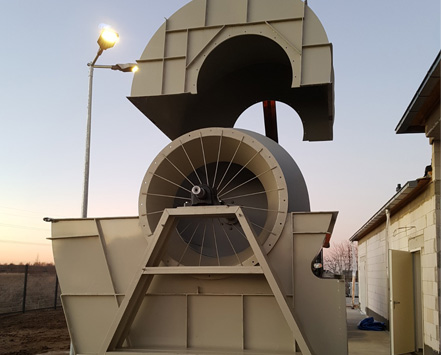
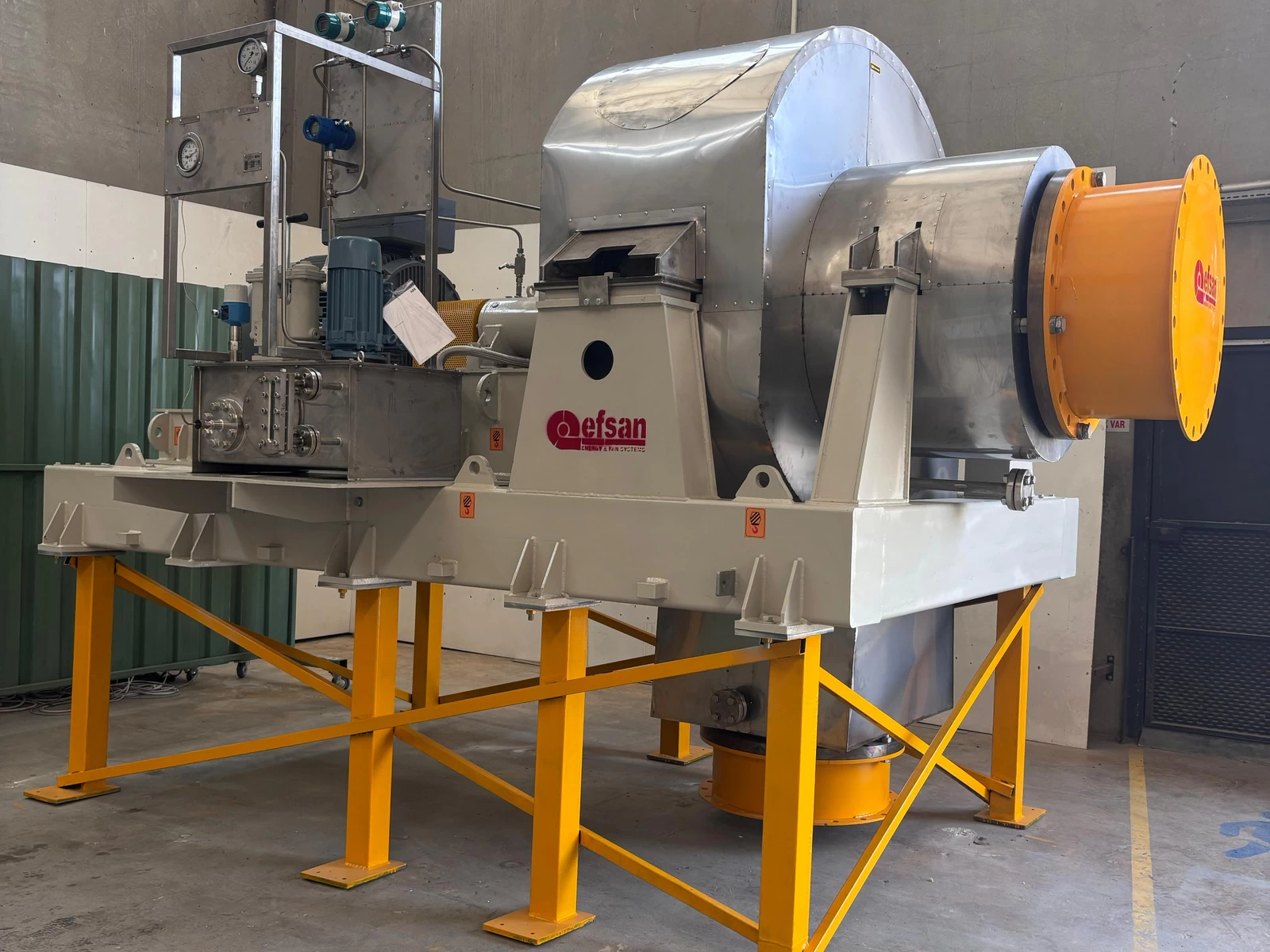
Industrial radial fans draw air centrally and expel it outward at high pressure through their blade structure, providing reliable airflow in long duct lines and applications requiring high static pressure.
Radial fans direct airflow by converting potential energy into kinetic energy at the centre. This mechanism is critical for processes requiring stable flow and pressure, particularly in systems with high resistance. A frequently observed reality in the field is that system performance declines and energy consumption exceeds expectations when the appropriate type is not selected.
This article may interest you. High-Efficiency Industrial Radial Fans: How to Determine the Right Fan for Your Process?
Critical Parameters in Radial Fan Selection: An Engineering Perspective
Flow rate, static pressure, ambient conditions, gas characteristics and operating conditions are the most important parameters that must be evaluated together for the correct fan selection.
Industrial radial fan selection should not be based solely on flow rate or power values. The following table summarises the critical technical parameters and their effects on the project:
| Parameter | Impact on System Performance |
|---|---|
| Airflow Rate (m³/h) | Ensures the required process air volume is delivered |
| Static Pressure (Pa) | Overcomes duct, filter, and system resistance |
| Operating Temperature | Determines material and motor selection |
| Gas Characteristics | Affects corrosion, abrasion, and fan durability |
| Operating Duty | Defines suitability for continuous or intermittent operation |
| Energy Efficiency | Directly influences operating and lifecycle costs |
High Efficiency: Beyond the Engine Engineering
Industrial radial fan efficiency is determined not only by the motor class, but also by the impeller geometry, the body’s fluid dynamics, and the proximity of the operating point to the optimum.
A fact we have observed in practice for years: Motor efficiency class alone does not guarantee sufficient performance. Real energy savings are achieved when the fan’s own aerodynamics, impeller design and operating point are kept close to the BEP (Best Efficiency Point).
Field Experience: Common Mistakes Leading to Loss of Productivity
The most common mistakes in projects are: selection based on catalogue data, incorrect calculation of duct resistance, and neglecting site conditions.
- Fan selection without considering duct resistance → Flow rate decreases, energy costs increase
- Impellers not properly balanced → Vibration and maintenance requirements increase
- Use of materials unsuitable for the environment → Wear and tear and premature failure
Radial Fan Types and Application Scenarios
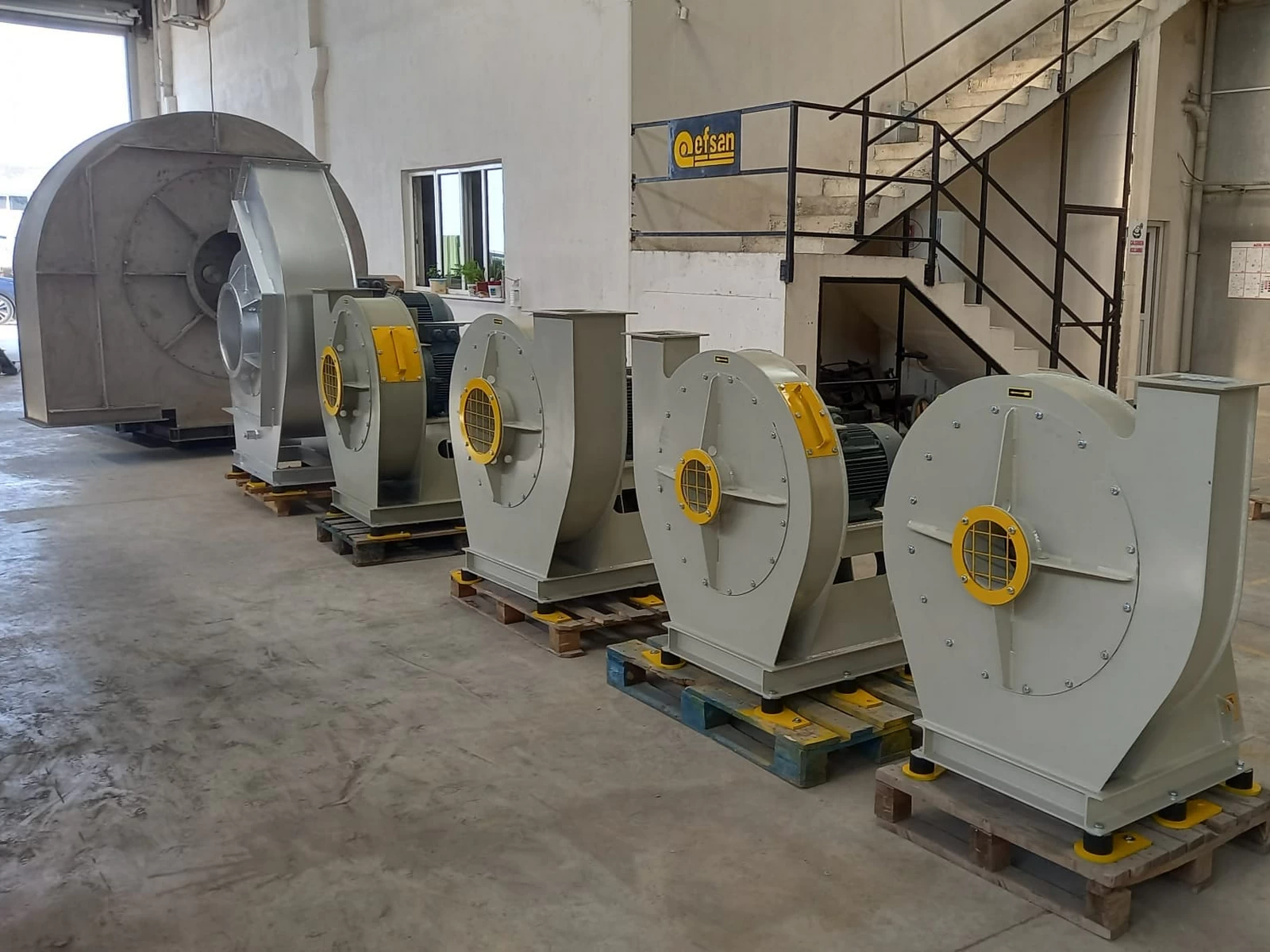
Radial fan types are selected according to different application requirements: backward-curved, forward-curved and straight-bladed.
| Fan Type | Pressure Capability | Efficiency Level | Typical Applications |
|---|---|---|---|
| Backward Curved | Medium to High | High | Filtration systems, process ventilation |
| Forward Curved | Low to Medium | Medium | HVAC systems, clean air applications |
| Radial Blade (Straight Blade) | High | Durable under harsh conditions | Dust-laden air, abrasive and heavy-duty processes |
Depending on the sector application, selecting the correct type both saves energy and extends maintenance cycles.
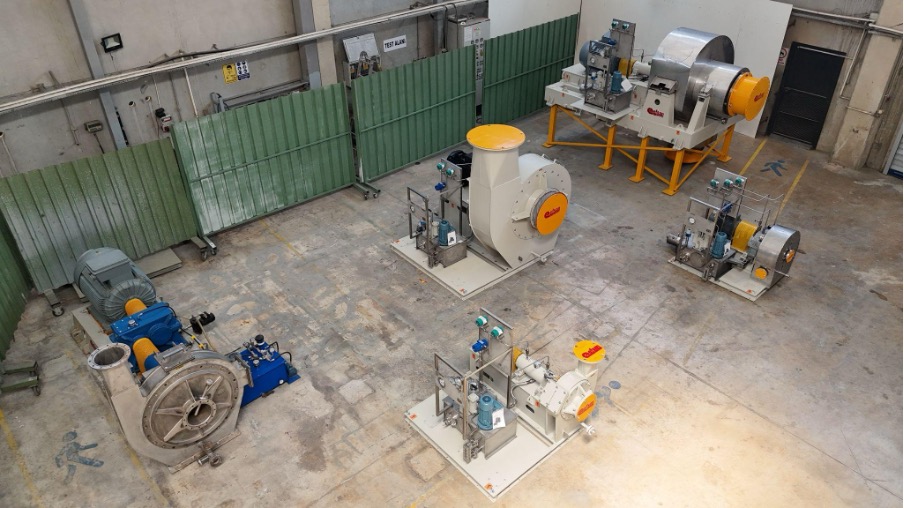
Productivity Enhancement Strategies
The foundation of efficiency in industrial radial fans lies in selecting the correct fan capacity, VFD-controlled operation, and regular maintenance. This approach reduces energy costs while maintaining production continuity.
The most critical strategy for efficiency is selecting a fan that fully meets the system’s needs and ensuring that this fan has a high-efficiency design. As we often see in practice, fans selected with capacities that are too large or too small lead to energy loss and mechanical wear in a short time. At this point, Efsan efficient radial fans are designed to provide maximum performance at the correct operating point.
Using fans with VFDs (variable frequency drives) prevents the motor from consuming unnecessary energy during variable flow requirements. This control method significantly reduces operating costs, especially in systems operating at partial loads. Our years of field experience clearly demonstrate that systems using VFDs operate more stably and have a longer equipment life.
However, regular maintenance and periodic checks ensure sustainable efficiency. Neglecting bearing, balance, and air path checks leads to unexpected downtime and production losses. On the other hand, with a planned maintenance approach, fans can be operated reliably and efficiently for many years.
In conclusion, selecting a high-efficiency radial fan of the correct value and supporting it with VFD control and regular maintenance enables businesses to both reduce their energy costs and ensure production continuity.
Cost Analysis: Total Cost of Ownership (TCO)
Industrial radial fan investment should be evaluated not only in terms of unit cost, but also in terms of operating, maintenance and energy costs.
The following should be taken into account in the TCO calculation:
- Initial investment
- Energy consumption
- Maintenance and spare parts
- System optimisation costs
The Right Fan: Not Just a Device, But a Strategy
Industrial radial fans are a critical component in terms of plant efficiency and process continuity. An appropriately selected fan, chosen with an engineering approach, increases energy efficiency; an incorrect selection, however, raises hidden operating costs.
At Efsan Makina, we offer solutions for industrial fan projects based on process analysis, field data and application experience. This approach ensures not only equipment but also sustainable performance.
For your industrial radial fan requirements, contact our company — let’s determine the solution tailored to your process together.
tags :
More about the sector and our business