Table of Contents
- Why is Fan Selection Critical in Acidic Environments?
- Why are Plastic Fans Advantageous Against Acid Vapour?
- Industrial Performance Range and Design Ability
- Safe Design in Chemical Processes Requiring ATEX
- Material Selection: Differences Between PP, PVC, PE and PVDF
- Typical Areas of Use in Acid Plants
- Long Life and Safety with Process-Specific Fan Solution
In chemical plants, fan systems are often regarded as ‘auxiliary equipment’. However, in environments containing acidic gases, solvent vapours and corrosive process air, the fan is not merely a machine that moves air; it is critical equipment that directly affects process safety.
Many problems encountered in acid plants—unplanned downtime, emission leaks, maintenance costs, and ATEX-related risks—are directly related to incorrect fan selection. Especially in processes where metal fans corrode quickly, chemically resistant plastic fan solutions have now become standard practice.
At this point, the issue goes far beyond the question of ‘plastic fan or metal fan?’ The right question is:
What material, design, and safety level are required for this process?
Why is Fan Selection Critical in Acidic Environments?
Fan selection in acidic and corrosive environments requires the simultaneous management of corrosion resistance, maintenance continuity, emission safety, and explosive atmosphere risks.
In environments containing acid vapour, the fan is continuously exposed to aggressive chemicals. This exposure affects not only the body but also the impeller, connecting elements, and sealing points. A common situation encountered in the field is that metal fans suffer surface loss and performance decline within a short time.
The consequences of this situation progress in a chain reaction:
- Fan efficiency decreases
- Balance is disrupted
- Vibration increases
- Bearing and motor life shortens
- Unplanned maintenance downtime begins
We have observed a reality in practice for years: Fan-related downtime often costs much more than the fan itself. This is because downtime in chemical plants means production loss, environmental risk, and occupational safety issues.
Therefore, fan selection is not just about ventilation; it is part of the process safety decision.
In Which Chemical Environments Is It Used?
Acidic environments are not uniform. Each chemical reacts differently with different materials. Plastic fan solutions are particularly preferred in the following processes:
- Production lines with HCl vapour
- Alkaline processes using NaOH
- Facilities where sulphuric acid fumes are generated
- Galvanising and pickling lines
- Battery and accumulator production facilities
- Scrubber exhaust air extraction systems
The common factor in these areas is the rapid deterioration of metal equipment.
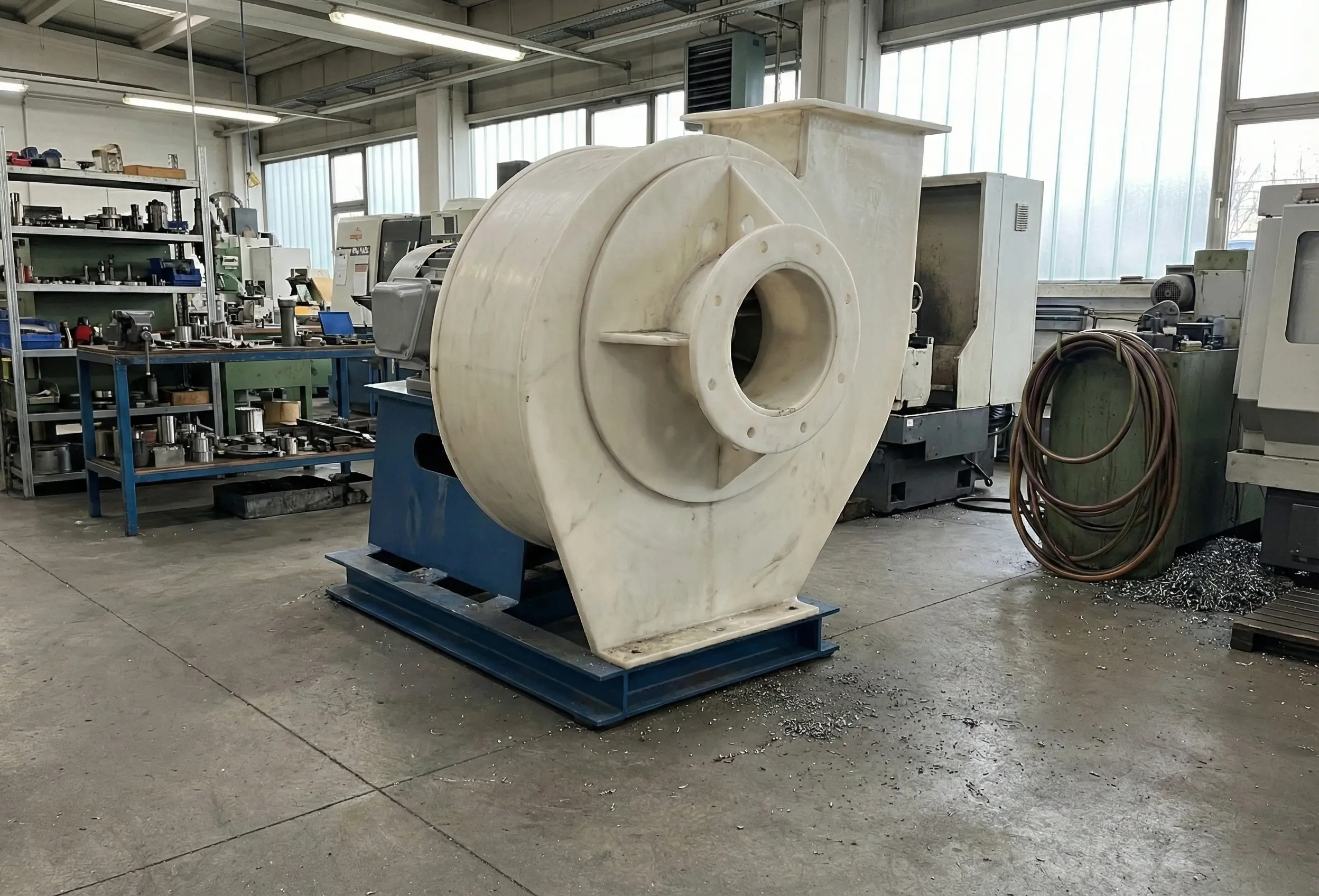
This article may interest you. Plastic Fans: Powerful and Reliable Solution for Chemical and Corrosive Processes
Why are Plastic Fans Advantageous Against Acid Vapour?
Plastic fans offer high corrosion resistance against acid vapour, a long service life and low maintenance requirements thanks to their chemically resistant polymer structures.
It is important to make a distinction here. The advantage of plastic fans is not that they are ‘plastic’. The real value lies in the chemical resistance of the polymer used.
Materials such as PP, PVC, PE and PVDF behave much more stably than metal against acids and bases. This stability ensures that the fan operates at the same performance level for many years.
A metal fan initially provides adequate performance. However, corrosion begins within a few months. Paint and coating solutions are temporary. Ultimately, the fan either fails completely or requires major overhaul.
With plastic fans:
- There is no surface loss due to corrosion
- No coating or paint is required
- Performance is more predictable
- Maintenance intervals are extended
According to generally accepted applications, plastic fans significantly reduce the total cost of ownership in corrosive processes.
Industrial Performance Range and Design Ability
Industrial plastic fans can be developed specifically for the process to meet high flow, high pressure and chemical-ATEX requirements in the same design.
Plastic fans are often misconceived as “low capacity” or “auxiliary equipment”. However, modern plastic fan systems used in industrial applications are specially designed for chemical processes requiring high flow rate and high pressure.
While metal fans lose performance in a short time due to corrosion, plastic fans produced with the right material and geometry continue to operate stably under the same conditions. This difference is not only due to the material of the fan; It arises from the aerodynamic design, impeller geometry and engineering adaptations made according to process conditions.
Industrial plastic fan solutions can be designed to cover a very wide operating range. Systems depending on the application:
- It can produce air flow rates between 500 m³/h and 300,000 m³/h
- Can create pressure difference up to 500 Pa
- Can reach efficiency levels of up to 60% with proper design
These values indicate that plastic fans are used not only for local suction; It shows that it can also be used safely for main process ventilation, scrubber fans and central chemical exhaust systems.
In terms of operating temperature, most chemical processes lie in the range of 0 – 80 °C. This range allows long-lasting operation of chemically resistant polymers such as PP, PPs, PVC, PE and PVDF. The stability of the system is maintained by selecting the body and impeller material according to the chemical content and temperature of the environment.
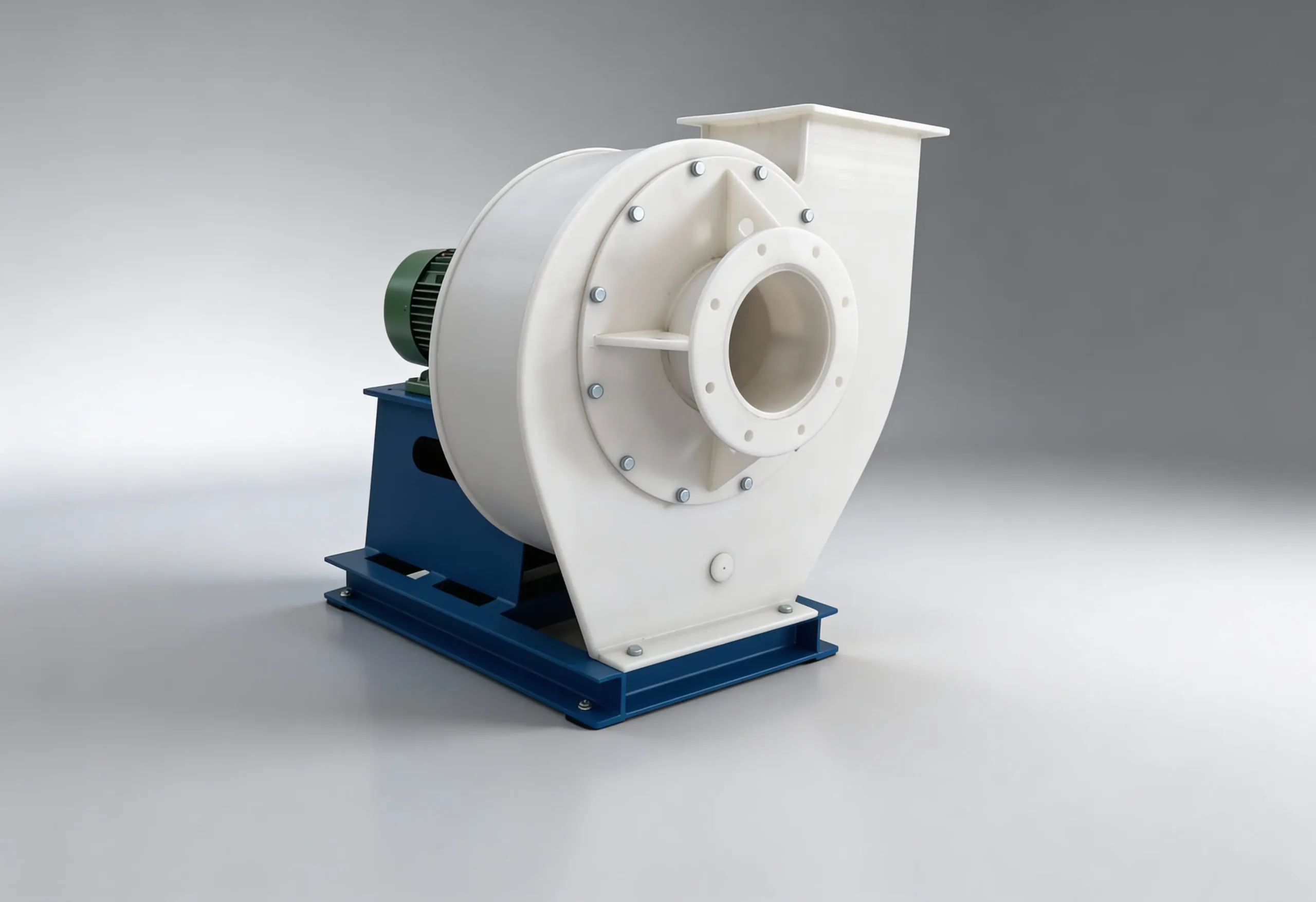
While PP, PPs, PVC, PE and PVDF are commonly preferred in fan bodies; On the impeller side, depending on the application, PP, PPs, PVC, PVDF or, in special cases, coated steel impeller solutions can be used. This flexibility makes it possible to optimize both chemical resistance and mechanical performance in the same system.
In processes requiring ATEX, performance alone is not sufficient. In areas with explosive atmosphere, the fan should:
- Prevents static electricity accumulation
- Minimizing the risk of sparks
- Compliance with the relevant zone class
is expected. Therefore, plastic fans produced in electrically conductive versions can be optionally made suitable for exhaust applications in ATEX Zone 2 or Zone 1 environments.
The most critical point we have seen in practice for years is this: High flow rate or high pressure alone is not a success criterion. The most important thing is that this performance can be maintained stably for a long time, together with chemical resistance and ATEX safety.
For this reason, industrial plastic fan solutions do not follow standard product logic; should be handled with a process-specific engineering approach. Thus, the correct and safe solution is obtained for both corrosive exhaust air and potentially explosive atmospheres.
Safe Design in Chemical Processes Requiring ATEX
Fan design in chemical processes requiring ATEX; It requires special engineering taking into account explosive atmosphere, static electricity and solvent vapors.
Many acid processes also present the risk of explosive atmospheres. Solvents, VOCs, flammable gases and vapors are a natural part of these environments. Therefore, the fan must be safe not only against corrosion but also against the risk of explosion.
One of the most common mistakes in practice is using a standard fan on a line that requires ATEX. This situation poses a serious risk for the facility.
For ATEX compliant plastic fans:
- Non-static, electrically conductive plastics are used
- Static electricity accumulation is prevented
- The risk of sparks is minimized
- Zone 1 and Zone 2 requirements are taken into account
As Efsan Makina, we design ATEX compliant, chemical resistant and high flow process fans specifically for the project. The aim is not only to comply with the legislation, but also to produce a safe and long-lasting solution in the field.
Material Selection: Differences Between PP, PVC, PE and PVDF
Choosing the right polymer for plastic fans depends on the chemical environment and temperature; Incorrect selection will seriously shorten fan life.
This part is where customers have the most difficulty. Because not every plastic is suitable for every chemical.
When the correct polymer selection is not made:
- Material becomes brittle over time
- Mechanical strength decreases
- Sealing problems begin
| Material | Chemical Resistance | Typical Application Area |
|---|---|---|
| PP (Polypropylene) | High resistance to acids and alkalis | General chemical fume exhaust systems |
| PVC (Polyvinyl Chloride) | Good resistance at moderate temperatures and common chemicals | Duct-type ventilation systems |
| PE (Polyethylene) | Suitable for specific chemical environments | Special process applications |
| PVDF (Polyvinylidene Fluoride) | Very high chemical and temperature resistance | Highly aggressive chemical processes |
Correct polymer selection determines fan life. We offer technical support on suitable material and fan design for your chemical process.
Typical Areas of Use in Acid Plants
Plastic fans are commonly used in tank ventilation, scrubber fans and chemical fume extraction systems in acid plants.
In the chemical industry, customers often do not look for a “plastic fan”. What he’s looking for is this:
- Corrosion resistant fan
- Chemical fume exhaust fan
- Scrubber fan manufacturer
- ATEX chemical process fan
Because the real problem is not the fan; It is corrosive and risky process air.
Areas where plastic fans are most frequently used:
- Acid tank ventilation systems
- Pickling and galvanizing lines
- Scrubber inlet and outlet fans
- Chemical fume extraction systems
- Waste gas neutralization units
In these areas where metal fans lose performance within 6–12 months, plastic fans become the most durable component of the system.
Long Life and Safety with Process-Specific Fan Solution
In chemical plants, the fan is not an auxiliary equipment; It is process safety equipment. Although standard products seem to work in the short term, they come with maintenance, downtime and security costs in the long term.
Our focus is not to sell standard fans, but to offer process-specific engineering solutions.
The chemical environment, ATEX requirements and performance expectations are evaluated together. The result is a long-lasting, safe and sustainable fan system.
Contact our company to choose the material and fan suitable for your project.
Let our technical team determine together the most appropriate solution for your process.
tags :
More about the sector and our business